NAD+ (nicotinamide adenine dinucleotide) is a coenzyme found in nearly every cell. It carries electrons in the reactions that turn food into ATP, the energy cells use, and it helps enzymes that repair DNA. That biological role is well established; health benefits from prescribed NAD+ preparations are a separate, less certain question.
This is a biochemistry explainer: what the molecule is, how the NAD+/NADH cycle turns, what role it plays in energy metabolism, and what else it does as a cofactor. None of it is medical advice or a claim about results.
A pilot study of intravenous NAD+ measured metabolites in eight treated participants and three controls; it did not establish clinical benefits or a subcutaneous dosing schedule. Source: NAD+ intravenous pilot study
What does NAD+ stand for?
NAD stands for nicotinamide adenine dinucleotide. It is a coenzyme, a small molecule that an enzyme needs in order to do its job. You find it in essentially every living cell, from a bacterium to a human neuron, because it performs a function so fundamental that life would not run without it.
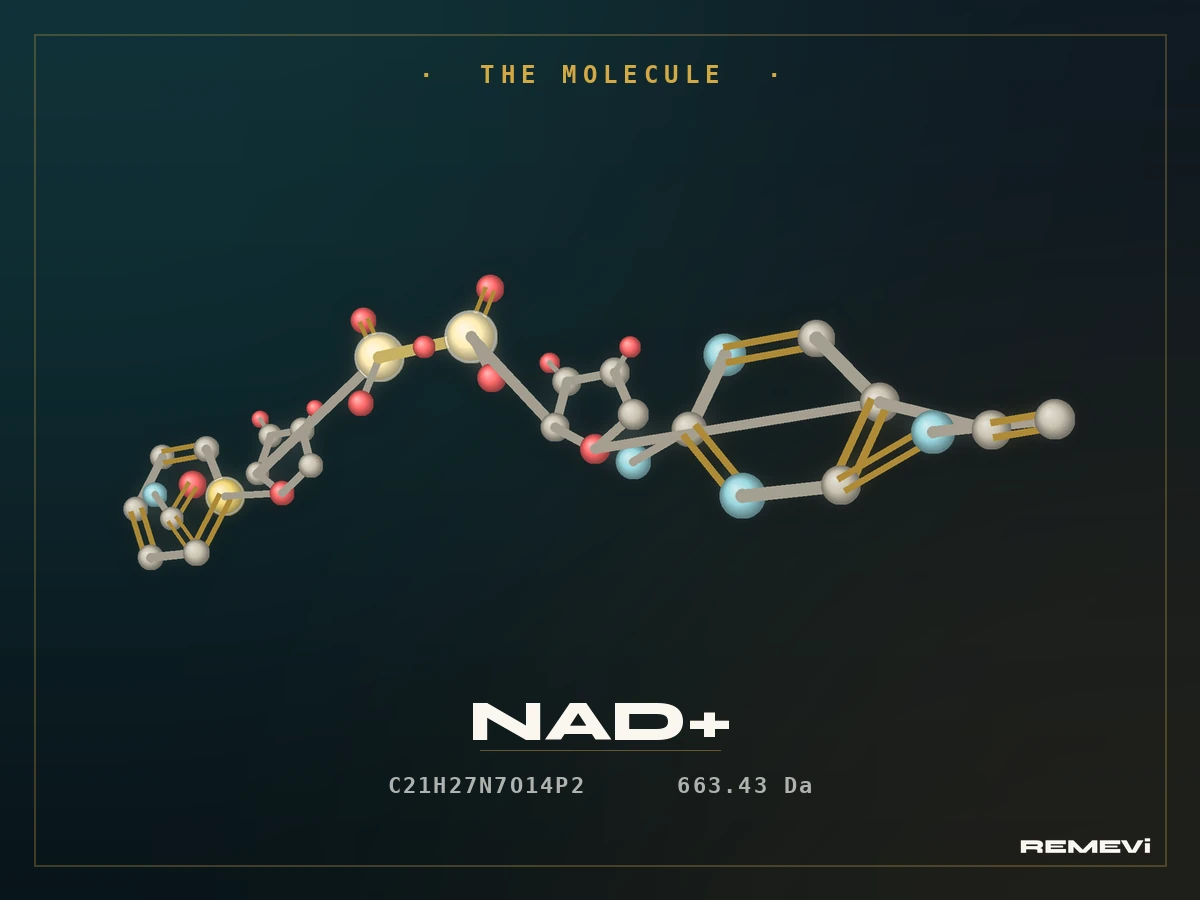 The NAD+ molecule and its role as a redox coenzyme. NAD+ accepts electrons as nutrients are broken down and becomes NADH; when it delivers them in the mitochondria, it returns to NAD+. That continuous cycle is the hub of cellular energy metabolism.
The most-cited description in the scientific literature is direct: NAD is “a coenzyme for redox reactions, making it central to energy metabolism,” according to the review published in Nature Reviews Molecular Cell Biology in 2021. That sentence captures the whole story. NAD exists to move electrons from one place to another, and moving electrons is, at bottom, what energy production is about.
What is the difference between NAD+ and NADH?
NAD has two forms that turn into each other constantly. The oxidized form is written NAD+ and has the capacity to receive electrons. The reduced form is written NADH and is the one already carrying them.
When your body breaks down the glucose or fat from a meal, those molecules release electrons. NAD+ picks them up: it accepts two electrons and a proton and becomes NADH. Think of NAD+ as an empty truck rolling past the production line, collecting a load of electrons and becoming NADH, the loaded truck.
That loaded truck has a destination. NADH carries its electrons to the mitochondria, the part of the cell where most energy is generated, and hands them to complex I of the electron transport chain. Once it drops the load, NADH reverts to NAD+ and is free to begin another round. The recycling is relentless: the same molecule is oxidized and reduced thousands of times.
One detail shows how finely tuned the system is: in healthy tissue, the ratio of free NAD+ to NADH is very high, which keeps the cell ready to keep oxidizing fuel. That ratio functions almost like a gauge of the cell’s metabolic state at any moment.
NAD+ at a glance
| Role | What NAD+ does | Where |
|---|
| Electron carrier (redox) | Accepts electrons from nutrients and becomes NADH; NADH hands them on and returns to NAD+ | Cytoplasm (glycolysis) and mitochondria (Krebs cycle, electron transport chain) |
| Energy production | Keeps the pathways running that end in ATP, the cell’s energy currency | Mitochondria |
| Enzyme cofactor | Consumed by sirtuins, CD38 and PARPs, enzymes involved in DNA repair and protein regulation | Throughout the cell |
| Made from | Forms of vitamin B3 (niacin, nicotinamide, NR) and the amino acid tryptophan | Built by the cell’s own pathways |
What does NAD+ do in the body?
This is where the cycle connects to the energy you actually use. NAD takes part in the three central stages of energy metabolism, and it is worth naming them precisely because each one depends on it.
In glycolysis, which happens in the cytoplasm, glucose is split into smaller molecules and, in the process, NAD+ is reduced to NADH. In the Krebs cycle (or citric acid cycle), inside the mitochondria, still more energy is pulled from those molecules and more NADH is generated. And in the electron transport chain, NADH finally hands over its electrons, which pass from one complex to the next, releasing energy along the way.
That energy is not wasted: it is used to pump protons across a membrane and create a gradient, a kind of chemical battery. That battery drives the enzyme ATP synthase, which makes ATP, the energy currency the cell spends on everything it does. Without a steady supply of NAD+ to feed this circuit, all three stages would stall. That is why NAD is described as central to energy metabolism: it is not a bit player, it is the carrier that connects food to ATP.
If you are curious how other molecules act inside the body at the level of mechanism, how GLP-1 works in the body walks through the same idea of receptors and signals applied to a different class of molecule.
Beyond redox: NAD as a cofactor
Electron transport is NAD’s most familiar role, and NAD has other roles too. The same 2021 review describes NAD as “an essential cofactor for non-redox NAD+-dependent enzymes,” among them the sirtuins, CD38, and the poly(ADP-ribose) polymerases (PARPs).
What do those enzymes do? Broadly, they take part in processes such as DNA repair, chromatin organization (the way genetic material is packaged), and the regulation of other proteins’ activity. The important difference is that these enzymes consume NAD: they spend it as a substrate rather than simply recycling it. That means NAD is more than a cog in the energy motor; it is also a molecule the cell uses to coordinate maintenance and signaling tasks.
All of this is established biochemistry about the NAD molecule itself, documented in the scientific literature. It describes what NAD does inside any cell, and it is not a claim about what a specific preparation can do for a person.
Is NAD+ available as a prescription?
With the biology clear, it is worth explaining where NAD+ fits into what REMEVi offers, and doing so with the same honesty. REMEVi’s Wellness Injections & Drops with NAD+ are a wellness preparation prescribed by a licensed provider, made by a state-licensed US compounding pharmacy under an individual prescription. The framing is simple: cellular wellness, within what a clinician judges appropriate for a given case. The full overview, including the three forms, is on the NAD+ injections page.
What this is not: it is not a product that promises performance, or results of any kind, or one that has been tested in clinical trials as a finished preparation. The science you read above is about the NAD molecule, not about the preparation. That distinction is exactly what separates an honest scientific explanation from advertising.
The preparation can be offered as a subcutaneous injection, a nasal spray, or oral drops, and the form is decided by the provider. Current plan prices, the same at every dose, are on the NAD+ injection cost page, and a needle-free option is explained on the NAD+ nasal spray page. Because it is a prescribed preparation, it always starts with a consultation. See how a visit works: a licensed clinician reviews your history and decides whether it is appropriate for you, with a care coordinator on the follow-ups.
Is NAD+ safe to take?
The biochemistry above does not answer that question. Prescribed NAD+ is compounded and not FDA-approved, and its safety depends on the ingredient source, sterile preparation and clinical oversight. FDA has received reports of severe reactions after injectable NAD+ linked to ingredient quality. Are NAD+ injections safe? covers FDA status and what to check.
The takeaway
NAD is a coenzyme that carries electrons. In its oxidized form, NAD+, it collects electrons from nutrients and becomes NADH; in the mitochondria it delivers them and reverts to NAD+. That cycle feeds glycolysis, the Krebs cycle, and the electron transport chain — the pathways that end in the ATP your body spends. NAD also serves as a cofactor for enzymes that repair DNA and regulate proteins. That is what NAD is and what it does: no more, no less.
When a NAD+ preparation enters a health conversation, the science of the molecule and the clinical decisions are two separate things. The first is what you read here. The second is one a clinician makes with you.
Your Health. Your Terms. Talk to a real clinician at remevihealth.com.
This article is for general information and does not constitute medical advice. REMEVi’s Wellness Injections & Drops are wellness preparations made by a state-licensed US compounding pharmacy under an individual prescription from a licensed provider. They are not FDA-approved as finished products and have not been clinically studied as such. Eligibility is determined by a clinician. Consult a licensed provider before starting any prescription treatment.
Injectable preparation safety
FDA has received reports of severe chills, shaking, vomiting and fatigue after NAD+ injectable medicines, with some patients requiring medical care. It warns that food-grade ingredients are unsuitable for sterile compounding. Those reports do not establish a risk frequency for a particular preparation. Source: FDA: ingredients for sterile compounding