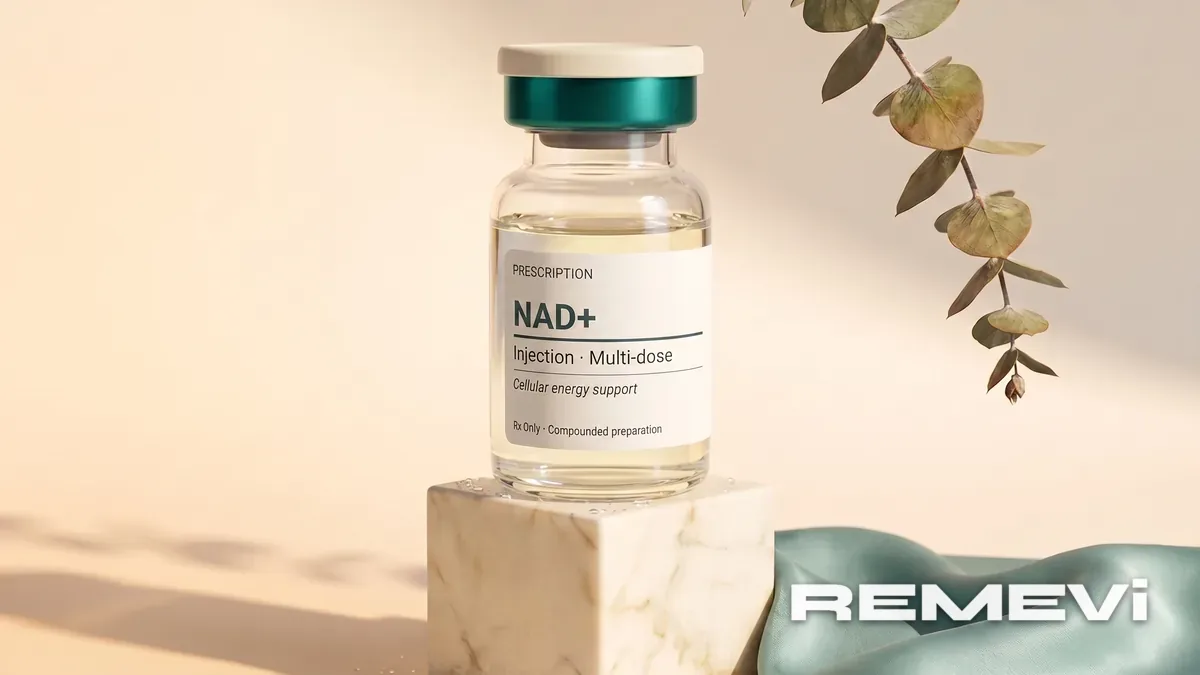
There is no standard NAD+ before and after. Research has not established whether, or when, at-home NAD+ injections change how people feel, and testimonials cannot show that. What people most often notice first are side effects such as injection-site redness or flushing. A licensed provider can set a goal and a time to reassess.
A pilot study of intravenous NAD+ measured metabolites in eight treated participants and three controls; it did not establish clinical benefits or a subcutaneous dosing schedule. Source: NAD+ intravenous pilot study
What NAD+ is, briefly
NAD+ is a coenzyme central to how cells turn nutrients into energy. REMEVi prescribes it for general wellness, after a licensed provider’s individual evaluation — full overview on NAD+ injections, with a science explainer on what NAD+ is.
What you might notice, and what is not established
| Stage | What is known or commonly reported | What is not established |
|---|
| First doses | Side effects are what people most often notice: redness or tenderness where they inject, flushing, nausea, tiredness | Whether these early effects say anything about later benefit |
| Blood levels | NAD+ treatments can raise NAD+ or its metabolites in blood, as a small IV pilot study measured | That higher blood levels change how people feel or age |
| Over weeks of treatment | Some people report changes in how they feel; these are personal accounts | A timeline, a typical result, or a controlled trial of at-home injections |
| Review point | Your provider can set a goal and a date to reassess whether to continue | A guaranteed outcome for anyone |
How long does NAD+ take to work?
There is no established timeline. Blood NAD+ levels can change soon after a dose, but no study has shown when, or whether, at-home NAD+ injections change how people feel. Any effect people describe varies widely from person to person. A licensed provider can agree a goal with you and a point to review whether continuing makes sense.
What do people notice after NAD+ injections?
Early on, the most common things people notice are side effects such as redness where they inject, flushing or nausea. Some people report changes in how they feel, but those are personal accounts, not controlled evidence, and they are affected by sleep, diet and expectation. Research has not established a standard result.
For what those early effects mean and when to call your care team, see NAD+ side effects and are NAD+ injections safe.
Why there’s no universal “before and after”
Two reasons stack up here:
- It’s individualized. Dose, form, and schedule are set per patient, so courses aren’t comparable.
- The evidence is still emerging. For many of the outcomes people search “before and after” hoping for, the human data isn’t settled (see NAD+ benefits for the honest breakdown).
Add the fact that compounded NAD+ isn’t FDA-approved as a finished product, and you can see why a stranger’s before-and-after tells you very little about your own situation.
How to read results content critically
Run any “results” content through three filters:
- Is it from a licensed provider, or a marketer?
- Does it acknowledge that results vary and the product isn’t FDA-approved as a finished drug?
- Does it promise a specific outcome? Specific guarantees are a red flag.
A lot of NAD+ before-and-after content fails all three.
What a provider can actually offer
Instead of a transformation promise, a serious program offers an honest, individual assessment: whether NAD+ is appropriate for you, what’s realistic, what they’d monitor, and when they’d reassess. That’s worth more than any gallery.
Want a realistic, individual picture? Start a clinical evaluation with REMEVi — a licensed US provider reviews your case before anything is prescribed, with bilingual care. Plan prices are on the NAD+ injection cost page.
Related reading: NAD+ benefits and NAD+ injections vs IV therapy.
This article is for general education and is not medical advice. NAD+ prescribed by REMEVi is a non-FDA-approved compounded medication that requires a prescription from a licensed provider after an individual evaluation. Individual results vary.
Injectable preparation safety
FDA has received reports of severe chills, shaking, vomiting and fatigue after NAD+ injectable medicines, with some patients requiring medical care. It warns that food-grade ingredients are unsuitable for sterile compounding. Those reports do not establish a risk frequency for a particular preparation. Source: FDA: ingredients for sterile compounding