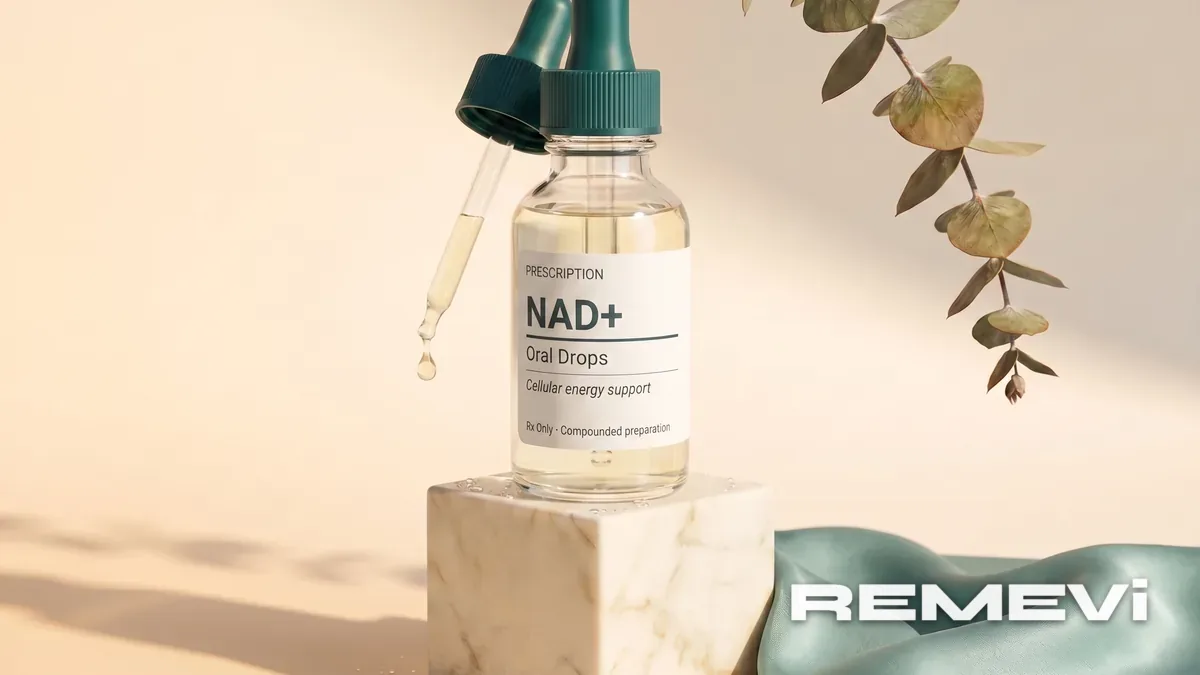
NAD+ supplements are over-the-counter pills or powders, often precursors such as NMN or NR, sold without a prescription. NAD+ injections are a compounded preparation that requires a prescription, given under the skin after a clinical evaluation. They differ in form, regulation and oversight; neither has been shown to improve how people feel or age.
A pilot study of intravenous NAD+ measured metabolites in eight treated participants and three controls; it did not establish clinical benefits or a subcutaneous dosing schedule. Source: NAD+ intravenous pilot study
NAD+ supplements vs injections at a glance
| NAD+ supplements (pills, powders, drinks) | Prescribed NAD+ injections |
|---|
| Form | Taken by mouth | Injected under the skin at home |
| Prescription | Not needed | Required, after a clinical evaluation |
| What it contains | Often a precursor (NMN, NR, niacin) rather than NAD+; varies by brand | NAD+ compounded by a licensed pharmacy for one patient |
| Evidence | Some precursors raise NAD-related blood measures; no shown change in how people feel or age | No trial of at-home subcutaneous NAD+; human research is mostly on IV and precursors |
| Oversight | Dietary-supplement rules; not pre-approved for safety or efficacy | Licensed prescriber and pharmacy; compounded, not FDA-approved |
What is the difference between NAD+ supplements and injections?
- NAD+ supplements are over-the-counter products sold without a prescription. Many are precursors (NMN, NR) rather than NAD+ itself, and the category is loosely regulated, so what’s actually in the bottle varies by brand.
- NAD+ injections are a provider-prescribed compounded medication, prepared by a state-licensed pharmacy after a clinical evaluation. The full overview is on the NAD+ injections page.
These are different categories with different oversight — even when both use the word “NAD.”
Do NAD+ supplements work?
Human studies show some oral precursors can raise NAD-related measures in the blood. That is a laboratory change, not a health outcome: the studies have not shown that supplements change energy, focus or aging in people. NAD+ itself is well understood as a coenzyme central to cellular energy metabolism (see what NAD+ is); how much a supplement changes that in a person is less settled.
Are NAD+ pills as good as injections?
No study has shown that either form is better for a health outcome. The practical differences are these:
- Delivery. Oral supplements pass through digestion; injections bypass it. That is a difference in route, not a demonstrated difference in results.
- Oversight. A supplement comes with no clinical relationship. A prescribed injection includes evaluation by a licensed provider, a state-licensed pharmacy and a care team.
If you want to avoid needles, a prescribed NAD+ nasal spray is another route a provider can discuss.
Is it safe to take NAD+ supplements with injections?
Tell your provider about every supplement you take, including NMN, NR or niacin, before starting prescribed NAD+. Taking several NAD-related products together has not been studied for safety or benefit. Injectable NAD+ carries its own considerations, such as sterile preparation and ingredient quality, covered in are NAD+ injections safe?.
How much do NAD+ injections cost compared with supplements?
Supplements usually cost less up front but come with no evaluation or oversight. A prescribed plan includes the clinical evaluation, the prescribed preparation if approved, supplies and shipping, with the same price at every dose. Current plan prices, and how they compare with clinic and IV sessions, are on the NAD+ injection cost page.
Considering a prescription option? REMEVi prescribes NAD+ online — injection, nasal spray or oral dropper — after a licensed US provider reviews your case, with bilingual care.
Related reading: NAD+ injections vs IV therapy and NMN vs NAD+.
This article is for general education and is not medical advice. NAD+ prescribed by REMEVi is a non-FDA-approved compounded medication available by prescription from a licensed provider after an individual evaluation.
Injectable preparation safety
FDA has received reports of severe chills, shaking, vomiting and fatigue after NAD+ injectable medicines, with some patients requiring medical care. It warns that food-grade ingredients are unsuitable for sterile compounding. Those reports do not establish a risk frequency for a particular preparation. Source: FDA: ingredients for sterile compounding